Tuesday, December 9, 2008

Book Report - New Year's Resolution

Not sure if we’re into the New Year’s resolution territory yet but here goes; if you make one New Year’s Resolution this coming year, be resolved to read more.

I’m not talking about newspapers (Do people still read those?), blog posts or twitter feeds here. I’m talking about books. Pick up a book that interests you and read it! And then do it again and again...

I’ve set a personal goal of 2 books per month for the year. We’ll see how I do. My plan is to review the books here and give some insights into their content and application.

Here’s my first review.

The E Myth -- Revisited, by Michael E. Gerber
Why Most Small Businesses Fail and What to Do About It (The dog-eared book to the right is my own personal copy from 1995).
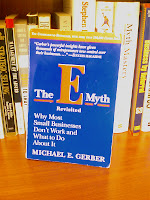
The subhead says it all! As you know if you’ve read my other posts, I’m all about overcoming the small business epidemic (a term that I coined several years ago), which gets right to the point that “most” small businesses don’t work, or fail.

Needless to say this book speaks to me. Actually, it's been speaking to me for years and was instrumental in the development, structure and continuing success of my own business, Cazbah.

The term E Myth relates directly to the Myth that; I am an Entrepreneur, therefore I know how to start, run, manage and succeed at a small business. The data regarding small business failures in this country say otherwise. In fact, most small businesses are started by what Gerber refers to as “technicians,” people that make things or do things and start a business because they think they have a better way of making or doing things. I’ve always related the difference between leaders and managers to this point, namely – managers do things right, leaders do the right things. So simple, so relevant…

One of the characteristic pinch points for entrepreneurs is that they can never seem to get ahead. Gerber refers to this as working in the business, rather than working on the business. They are so busy making stuff that they never raise their eyes to the horizon to see what’s coming or where they are going. Like walking across a field looking at your feet. You may never get to the other side...

There are many, many small businesses (most actually) that I’ve interacted with over the years that are in a perpetual vicious cycle. They go out to their markets sell something, bring it back to the shop and build it, go out sell something, bring it back build it..(repeat). Their financial results porpoise as a result. Picture the fish (o.k., mammal), above the water - below the water - above the water - below the water, etc… It never ends and they never really grow or get ahead. They just exist like this, in some cases from one generation to the next.

Gerber offers some simple and actionable advice on how to correct the E Myth through the development of the Franchise Prototype. This is a business model that adopts the attributes of a franchise business. He goes to great lengths to give credit where it’s due (Ray Crock – McDonalds). Here’s a little tidbit to give this point some credence. “Regular” small businesses fail at a rate of 70% – 80%. Franchises succeed at a rate of 75%. Get the point? As an aside, for the entrepreneur considering a business venture, being a franchisee may represent your best choice!

Most small businesses lack structure and any repeatable process documentation, the attribute that truly defines the franchise business model. Gerber contends that the strategic systemization of your small business will reap huge returns and resolve the E Myth… and he’s right!

If you are 1) an Entrepreneur, 2) business owner or manager, 3) considering becoming an Entrepreneur, 4) may someday be in a position of business management, 5) are currently employed or, 6) are considering employment… (you get the point): You owe it to yourself to read this book!

Michael Gerber’s E Myth is what I consider to be one of the foundational texts that every small business should have on its book shelves and have in practice! Buy it and read it.

eStrategy... 3 Simple Steps

Practically speaking, a large percentage of a small group is a ‘bigger’ and more meaningful number, than a small percentage of a large group. Gaining this large percentage of a highly targeted group of customers, or market segment -- commonly referred to as market share – should be the primary objective of any business. The success of your eStrategy is defined by your ability to:

1. Find this highly targeted group of customers

2. Communicate with them

3. Get them to make a purchase

The Great Equalizer
In the past, this level of marketing focus was restricted to those companies that had the research, advertising, and direct response budgets to support it. Not anymore! No longer do you have to be a Fortune 500 company with a multimillion-dollar budget to market effectively to a highly targeted group of customers and prospects. In this case, the Internet is the great equalizer. The major direct response marketing agencies realize this fact. They are currently busying themselves with the conversion of their traditional services to online services.

The More You Know…
The more you know about your customers and the better you understand them, the more likely you are to find them online. The important task is getting them to find you. There are several methods that you can use to do this. One in particular involves both traditional search optimization and pay-per-click, or search engine marketing (online advertising).

Communicating with your customers and prospects is a fairly straightforward proposition. There are numerous highly targeted online methods including eZines, e-Pubs, Communities (Social Media -- the list seems to be infinite these days) and eMail marketing campaigns, to name a few, which you can use to reach out to your market segment.

It’s all about focus!
If you do the appropriate amount of work on the ‘front-end’ – finding your customers and communicating with them -- the ‘back-end’ – getting them to buy your products or services -- will take care of itself. Ultimately, if you focus your eStrategy towards the specific identification of your target customers and prospects, communicating your UVP (unique value proposition) to them in response to their needs, they will buy your products or services!

Monday, December 8, 2008

Focus, Focus, Focus

When you boil it all down, success online is dramatically affected by one thing! Recently, a colleague and I were talking about success. Since he has given me good advice and friendly council over the years, he had my rapt attention while sharing pearls of wisdom from his 40+ year technology and business career.

My friend asked me, “Do you know what the secret to success is?” Almost without letting him get the words out I said, “No What?” After a dramatic pause he said, “One thing.” Remarkably, my friend’s appearance began to change to that of Jack Palance (Curly), from his Oscar winning performance in the 1991 classic City Slickers . I waited with bated breath for him to share this life-changing secret.

Nothing happened. He wasn’t saying anything. We were just looking at each other in silence, until finally I asked; “And that ’One Thing’ would be..?” A wry smile crept across his face. “I have no idea,” he said. “That’s for you to figure out. Whatever you decide, do it with all your heart and do it better than anyone else!” I got the point. My friend had reinforced a principal so basic and so true.

The principal of One Thing -- Focus, is especially relevant when applied to the Internet. A singular focus is fundamental to answering the question; “What’s it going to take to do business on the Internet?” The numerous elements, tactics really, that go into the development of an effective e-Strategy for your small business are important, without question. But, more important than any combination of any element or tactic is ..........FOCUS!

Who Needs a Unique Value Proposition Anyway?

(The importance of your differences cannot be overstated.)

The short answer to this question is, you do! If you want to do more business, more effectively on the Internet, then you definitely need a Unique Value Proposition.

The term Unique Value Proposition can be best understood by breaking it down into its parts.

Unique refers to the characteristics of your product or service offering that distinguish you from as many of your competitors as possible. Think about it. What is it about what you do that sets you apart? Take the time to really understand how you are different from your competition. Then, write it down!

Value is the intrinsic worth of your offering to your customers. In other words, it defines what your customers get for their money. If you’re having difficulty with this one, ask your customers to describe how your service or product has helped them. Take this input and translate it into several concise statements.

Webster defines Proposition as; a statement containing only logical constants and having a fixed truth or value. That pretty much sums it up! It is your factual and truthful proposal to your customer. Being able to qualify and quantify your claims is very important and makes your Unique Value Proposition that much stronger!

The Internet is a tremendous resource for gaining a better understanding for the UVP concept. There are numerous examples that you can find online through a search using any search engine, on the terms ‘Unique Value Proposition.’ Using the results of your search as a model, construct your own Unique Value Proposition.

Documenting your Unique Value Proposition and making it easy to understand is very important. As with goals, the elements of your Unique Value Proposition are not real until you have written them down. Once you have done so, place them somewhere that you are sure to see them. Reading them on a regular basis is an excellent test of their accuracy. Ultimately, your customer will determine how well you have captured your Unique Value.

As an aid in this process, ask yourself this question: “What is it about what we do that makes us different (better) and why should anybody care?” Combining your honest answer to this question with some objectivity and customer input will get you far along the path to identifying and documenting your Unique Value Proposition.

Use mind mapping to capture your Unique Value Proposition. Write your product or service features in the center of separate pieces of paper. Once you have documented the features in this way, draw a circle around each one. Then, write the benefits that your customers receive from that feature in smaller circles, surrounding the center. Connect the circles with lines, like spokes in a wheel. When finished, evaluate them all to ensure that they accurately represent your offering. Compile each feature map page into one sentence. Then, combine the sentences into an itemized list or paragraph. Congratulations, you have just created your Unique Value Proposition.

As indicated before, your customer will be the ultimate judge of the accuracy of your UVP. Take the time to test your newfound focus by sending it to some of your better, longer term customers to gain their insights. Their input will provide you with the finer points that will allow you to refine and sharpen your Unique Value Proposition even further.

All The Business!

CYBER BRAND

I wrote this article in 2005 for Business Strategies Magazine. It is as relevant today as it was then. Note in particular the emphasis on Trust in the last paragraph as it relates to the success you will achieve on the web!

Most small businesses are of the opinion that their website is like a billboard on the Information Superhighway. Unlike traditional billboards, having a website without promoting it effectively is an exercise in futility (It truly amazes me how many small business owners and managers still think this way).

If the majority of businesses that have had limited or no success on the Internet were honest with themselves they would acknowledge that they have no clear direction when it comes to the Internet. This manifests itself in their lack of focus and their inability to state, in no uncertain terms, why they are online.

Why Are You Online? The development of a very clear objective statement for your online activities is important because it will help you shape what is it that you intend to do specifically and why you are online?

Branding is a term that you hear most often in relation to big product names like Coca Cola, General Motors, Microsoft, and so on. Not so coincidentally, these are some of the most well known brand names in existence today. These companies recognize that the perception that exists in their customer’s minds, which is essentially the brand message, is a valuable commodity. It is so valuable that often times it is considered as the most valuable asset of any company. For example, the Microsoft brand, which is one of the most well recognized brands in the world, is worth 65 Billion dollars, according to Interbrand, the brand valuation company.

You may be thinking, how does that affect me and my start-up or small business? As follows: Those giant companies with their mega brand valuations didn’t start out as giants. They began life as somebody’s vision or dream in a basement or garage or in a back room somewhere. Over time they were able to define a very specific category or market segment and then dominate it. As a result, their brands came to be identified with that category or segment. The meaning of their brand names evolved accordingly and became associated with a positive image in the mind of the customer.

In their book, The Fall of Advertising and The Rise of PR, Al and Laura Ries submit that, “The best way to establish a brand is to create a new category...This is a revolutionary concept in the sense that it goes against conventional thinking.” They go on to say that, “Creating a brand and defending a brand are two major functions of a marketing program. PR creates the brand. Advertising defends the brand.” (Editorial comment: I really believe that Al & Laura kicked off the Social Media emphasis on the web, without even knowing it...)

Public Relations builds the brand. There have been more cases of brand building failures that were directly related to the misuse of advertising for this purpose, than most advertising and marketing people care to remember. It is incumbent upon you, the small businessperson, not to make the same mistakes .

In establishing your brand, it is important to follow the path of success mapped out by other successful brands many of which you most certainly are familiar with because they are household names. After defining your particular category you need to work diligently to associate your brand name with that category striving to establish that positive impression that will set you apart. The Internet represents the ideal opportunity through which to do this.

The Internet was created to enable communication, cooperation and collaboration. Public relations strives to do the same thing. Most people view PR (articles in newspapers & magazines, the news, editorial columns, etc) as the advice of a “trusted friend. You have the opportunity to establish this same level of trust using the Internet as a primary communications medium with your customers and prospects. Be cautious about the contents of your messages however. Try pushing a blatant advertising message through this medium and you will quickly loose that trust.

Everything about the design of your Web site should represent your unique position within your category and support the positive impression that you are striving to establish in the minds of your customers. In addition, the information that you make available to your Web site visitors needs to build on the philosophy that you are developing a trusting relationship with your customers and prospects.

Sunday, December 7, 2008

To Thine Own Self Be True...

I wrote the following article over 4 years ago and it was published in Business Strategies Magazine. It came up recently in a search result and I re-read it and pondered how, the more things change the more they stay the same. It really speaks to what the "Social Medium" is all about. Read and enjoy!

Like most great principles, integrity gets a lot of air time, but it is seldom a true way of life, especially on the Internet. How people love and value a man or woman of integrity. Integrity in everything he or she does, in relationships, in business. Unfortunately, this often seems to be the exception rather than the rule. We have tuned ourselves to distrust what we read and see because frankly, so much of it is spin or an all-out lie. If it seems too good to be true, it probably is…

When we hear the word integrity it often congers up an image of a stern and sober school master whose Quaker or Puritan upbringing shows through his innate inability to smile, joke or be happy. But this isn’t what I’m talking about when I say integrity. I am referring to that strength of character that shuns expediency and avoids the temptation to cut corners or shade the truth, no matter what.

Integrity is the key to success in any endeavor. Integrity is honesty and the truth, period. Shakespeare captured the essence of this in Hamlet; “And this above all, to thine own self be true. And it must follow as the night the day, thou canst not then be false to any man.” If we are honest, truly honest, with ourselves we cannot be dishonest with anyone. If our motto is integrity, we always have what we need. We sleep soundly resting in the assurance that we do not have to worry about what we have said or done.

Translating this principle to your efforts on the Internet is critical as you develop the contents of your website and online communications. Remember that the Internet is the quintessential and ubiquitous communications medium. By design it is everywhere, all the time. The communities that define the Internet, people (all of us) coming together around common interests, have unprecedented access to information, yours and everyone else’s. Therefore, make sure what you publish is honest and true. Simple, right?

The simple truth of the matter is that all of life is governed by the principle of cause and effect. We have all heard this law repeated in various forms from scriptural to cultural; You reap what you sow - For every action there is an equal and opposite reaction – What comes around goes around. Failure to heed this law will result in certain disappointment. This is especially true of the information that you publish and communicate, or the business that you do, on the Internet.

There is a term “Internet Time,” that gets bandied about in relation to the speed with which change occurs or things happen online. I have always correlated this term, or concept, to another very familiar concept, dog years, the 7:1 ratio of the age of a dog to a human. In other words, the dog ages 7 times faster than a human. The correlation is a simple one: Change occurs and things happen 7 times faster on the Internet than they do in the dirt-world.

At a purely pragmatic level, honesty is the best policy. Frankly, it is the only policy online. With the law of cause and effect and the concept of Internet Time in mind, imagine if you will the potential impact of putting information out there that isn’t absolutely true, or doing business online that is not honest according to our previous definition. Understand that this dishonest effort will most certainly bring those “chickens home to roost.” When and how significant the unfailing blow will be, nobody can tell. However, you can be sure that “the other shoe will drop.”

By comparison lets look at the upside potential of this example. If the information that you publish and the business that you conduct online is honest and true, it stands to reason that the reward that you will receive will come to you 7 times faster, right? Absolutely! Not only that but just as the punishment always seems to be greater than the crime, the rewards for our Integrity will be out of all proportion to our honest efforts. It is our choice.

Saturday, December 6, 2008

So what is the Small Business epidemic anyway?

Here goes my inaugural blog post (I know, it’s about time): There are two economies out there. The one we hear about all the time, every single day, from every conceivable direction. The economy that includes names like Paulson, Bernanke, CitiCorp, Wall Street, GM, Ford, Chrysler, UAW, Congress, etc. And then, there’s the one that we hear virtually nothing about, at least not at a national media level. Obviously, I am referring to “Big” (scoff) Business on the one hand and on the other hand of course I am referring to small business which, interestingly enough, represents the majority of our economy on multiple levels. We’ll get to what that means in just a moment (actually, I’ll grind on that forever).

The sub-heading on this blog really says it all. I am personally and professionally committed to overcoming the small business epidemic. We’ll get to the definition of what exactly that means in just a bit as well. Everyone needs goals, although most people don’t have them, and this happens to be one of mine. I refer to this statement of ostentatiousness, overcoming the small business epidemic, as my BHAG (beehag) or Big Hairy Audacious Goal. The term BHAG was originally posited by James Collins and Jerry Porras in their 1996 article entitled Building Your Company's Vision. They also incorporated it into their book, Built To Last - Successful Habits of Visionary Companies, a great read for sure.

I realize that permanently changing the face of small business in America may seem somewhat brash, but hey, that’s who I am. A manager (small business owner) once referred to me as Brash so, I looked it up and came up with the following definition; aggressively self assertive. Yep, that’s me. Now, I’m not one to apologize for who I am and I certainly don’t mean any offense to anyone but, I will not hold-back, kowtow or bend to conventional wisdom in this medium, or any other. Therefore, I will be forthright and truthful about what I know, what I see and what I hear in support of small businesses or in criticism of them in order to accomplish this goal.

No question about it, I will have plenty to keep me busy for my entire career. I doubt seriously that I will ever accomplish this goal based on conversations that I have had with thousands of entrepreneurs and small business owners over the last ten years or so.

Overcoming the Small Business Epidemic will require a radical new way of thinking about business and here’s why. As I mentioned earlier, small businesses in this country, not big businesses, represent the majority of our economy on several levels. According to the SBA – Small Business Administration small businesses:

1. Represent 99.7 percent of all employer firms!
2. Employ about half of all private sector employees
3. Make up 97.3 percent of all identified exporters…
3. Have generated 60 to 80 percent of net new jobs annually over the last decade
4. Create more than half of all non-farm private gross domestic product (GDP)

Here’s the gist of it; these small businesses that have such a marked and profound impact on the US economy, employing the majority of our workforce, are failing at an alarming rate! More statistics from the SBA: In 2007 there were an estimated 637,100 new businesses started. Approximately 560,300 small businesses were closed with approximately 28,322 ending in bankruptcy. Do the math… And here’s the epidemic part. It’s been this way for a very long time and it’s getting worse!

Here’s something else. Again according to the SBA a full one third of new businesses close their doors within the first two years. Fifty six percent close their doors after just four years and sixty nine percent go out of business by year number seven.

In summary, our economy is dependant to a very large and growing extent on small businesses, more than half of whom never make it to their five year anniversary. This as I’ve said is a problem of epidemic proportion and demands attention. I will endeavor in this blog to provide information, tips, methodologies, concepts and plans, resources, contact information, success stories and critical thinking in an effort to overcome the small business epidemic in America. I thank you in advance for your interest and consideration and welcome your comments – It’s going to be an interesting trip!